The Unfortunates by B.S. Johnson
"I fail to remember, the mind has fuses."

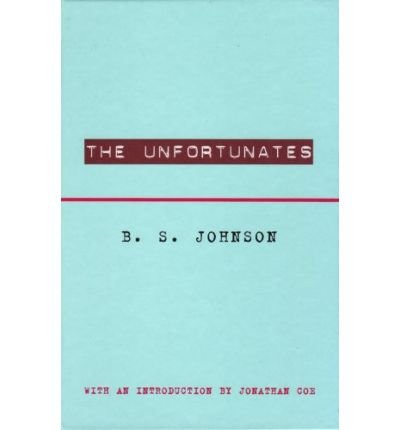
The Unfortunates by B.S. Johnson (Panther Books, 1969)
Book in a box! Book in a box. I've had B.S. Johnson's The Unfortunates sitting in my to-read pile for ages, living in fear of its very book-in-a-box-ness. First I'd have to break open the wrapper, and then decide whether and how to shuffle up the chapters. I'm not here to make tactical decisions. I’m not here for admin. I'm here to read three pages of something, fall asleep, and then hit myself on the nose.
On the off-chance you're not familiar, here's how it works. The Unfortunates consists of 27 short chapters, some just a single page, and all unbound. The first is called First, the last is called Last, and the other 25 are to be read in any order. The reader may "accept the random order in which the receive the novel" or they may shuffle it up themselves. Obviously I shuffled them. Can't risk Picador sneaking through a secret 'correct' order.
In his introduction Jonathan Coe notes that Johnson was "in many ways an embarrassment to the literary establishment. The feeling in his books was too raw, too upfront." But he positions this book as a forerunner of the confessional genre that emerged in the early 90s "in the wake of books by Blake Morrison, Nick Hornby, Frank McCourt and others." Of that list I've only read a few Hornbys, but while I can see the point, there's nothing of the active element of confessional writing here. Nothing is purged, nothing is forgiven, nothing is lifted or even really recontextualised. This is stranger and, I think, stronger for it, though that's probably just a question of tastes.
It is a beautiful thing: book as toy. Picador have included in the box the match report from the game, along with three epigraphs, two from Samuel Johnson and one from Lawrence Sterne. "I have often thought that there has rarely passed a life of which a judicious and faithful narrative would not be useful." Faithful is the key word there - Johnson was trying to solve the problem of "conveying the mind's randomness", which is naturally destroyed whenever the novelist presents everything down in one fixed, artistically significant order. And so he broke one of the founding principles of the form.
You could probably do something with an app, right? A novel that shuffles itself line by randomised pre-written line as the readers reads. You could even procedurally generate the whole thing. These fancy chatbots that may or may not end all written human endeavour are capable of spitting out up ghostly non-stories in the style of anybody you ask them to. But then at a certain level we are reading a novel to experience a written thing: a thing shaped for us, a thing shaped to do things to us and with us. If I want to experience the randomness of an actual mind helpless before its own mnemonic triggers I'll go and walk around somewhere I used to live.
And here's what's going on. Our narrator arrives in an unnamed English city - apparently you can tell it's Nottingham if you know Nottingham, which I don't, not really. He is on his way to cover a football match, but once he arrives he realises: "I know this city!" He knows it because it was here that his friend Tony lived and then died, taken young by cancer. And so his journey and his job are assailed by jags and rushes of memory, of Tony's decline and death, of a broken love affair, of talking and writing and working.
It's a wonky word, "experimental", as it gets attached to a novel. It offers both an insult and forgiveness, and neither is usually appropriate. It implies a work half-finished, still bubbling away in the laboratory. Just trying something, stand back everybody! Oh no, it's all on fire. Whereas this is certainly a complete and total thing, as finished as any novel ever is. It just works differently.
Thanks to a publishing error I got an extra copy of one of the chapters; at least, having counted back afterwards, I think it was a publishing error. But as I was reading it I wasn't sure if this was an accident or another provocation, another gesture towards the problem he was trying to solve. Memories repeat, after all. Sometimes for years. And were they exactly the same? I began to smell disintegration loops.
But as he said later, he didn't think he solved the problem completely, not least because one nagging thought is: he could have gone further. The chapters still curve in accordance with the novelist's art, and so with artifice; he still provides us with our on-ramp First and off-ramp Last. Why not each paragraph its own page, maybe even each line. The novel as an explosion in a fortune cookie factory; the novel as a box of flashcards. But that would have rendered the thing almost unreadable and, perhaps worse, totally unpublishable. At least in the 1960s.
Once I started reading it, the thing I was most surprised by was the fundamental un-oddness of the story. Johnson writes in wandering sentences that loop back and round on themselves —
And that evening we were at their flat, the four of us together, the flat on the outskirts of the city, near the ground, yes, where they were at that time, the trolleybuses stopped nearby, it was a terminus for them, another landmark or guide to the city Tony pointed out to us, carefully solicitous of our finding our way about, in what was for us a strange city, Tony.
— but the rigorously peculiar packaging hides a sad, delicate, occasionally sweet and surprisingly normal story. The weirdness is entirely structural. The extraordinary dislocation of ordinary memories.
If you're wondering, I wrote this in a more or less sensible order, then numbered the paragraphs, randomised the numbers, and rearranged them accordingly. All except the first one, and this last.